Moon visibility: precise lunar sighting and Hijri-calendar reference
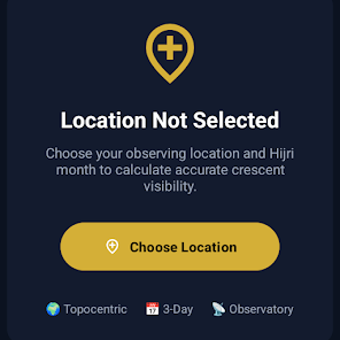
Moon visibility by Shahzad Naqshbandi is an Android tool for predicting crescent (Hilal) sightings and informing Hijri calendar decisions. It calculates Moon Age, illumination, altitude, azimuth, elongation, sunset/moonset and Moon Lag Time for chosen dates. The app supports location-based calculations via GPS or manual coordinates and lets users check future dates. Designed for astronomy enthusiasts, researchers, students, and religious observers who need accurate, calculation-based lunar data.
What the app delivers for crescent sighting
The app targets crescent (Hilal) prediction by supplying technical sighting metrics used in observance decisions. It reports Moon Age, illumination percentage and geometric coordinates, plus timing facts such as sunset, moonset and Moon Lag Time. These outputs come from on-device astronomical calculations, and the interface groups the numeric results for quick reference, which supports fact-based evaluation of visibility conditions.
How it supports observational learning and data literacy
The tool teaches users to interpret observational criteria by exposing the raw measures that matter to sighting. Presenting altitude, elongation and lag time encourages learners to compare numeric thresholds rather than relying on photographs. The app’s ad-free presentation reduces distractions during analysis, and showing values for specific dates helps learners practice forecasting and verifying visible crescent conditions against real observations.
Is it suitable for beginners, students, or specialists?
The app suits a spectrum of learners from motivated students to specialist observers because it supplies technical metrics used by researchers and religious authorities. Beginners can use date selection and phase tracking to follow changes over time, while advanced users get precise coordinates for detailed study. The app runs on Android and accepts device location or manual coordinates, so learners can apply it in fieldwork or classroom demonstrations.
Can users track phases and customise predictions?
The app allows selection of specific dates and includes lunar phase tracking to observe changes across a month, which supports project-based learning and planning. Location-based computation is available through device coordinates or manual entry, enabling comparisons between sites. These capabilities let learners investigate how sighting prospects vary by place and time, turning raw calculations into repeatable observation exercises.
Recommended for observers and learners who need calculation-based lunar data
Moon visibility is a precise reference for observers and students who require numerical evidence to decide Hijri dates or study lunar behaviour. Because the app emphasises technical sighting criteria rather than classroom workflows, educators should plan supplemental materials if they need assignment or grading features. The app suits anyone focused on factual, calculation-driven lunar planning and observational exercises.